The Clan Rose Connection
Across the high Middle Ages, the name de Ros (Roos/Rose) shone in the northern baronage of England—from Helmsley in Yorkshire to Roos in Holderness—within an Anglo-Norman world whose families, fashions and alliances moved easily along the North Sea routes. In broad outline, the Coley–Vachell story touches that fabric at two points of descent from the Helmsley de Ros, which in turn filter—over several generations—into the Yorkshire gentry and finally into late-seventeenth-century Berkshire. By the time Françoise ("Frances") Vachell (1674–1728) stands at Coley Park, those medieval strands have already passed through fifteenth- and sixteenth-century Yorkshire houses (notably Calverley) and are poised to cross the water into Sweden in the early eighteenth century.
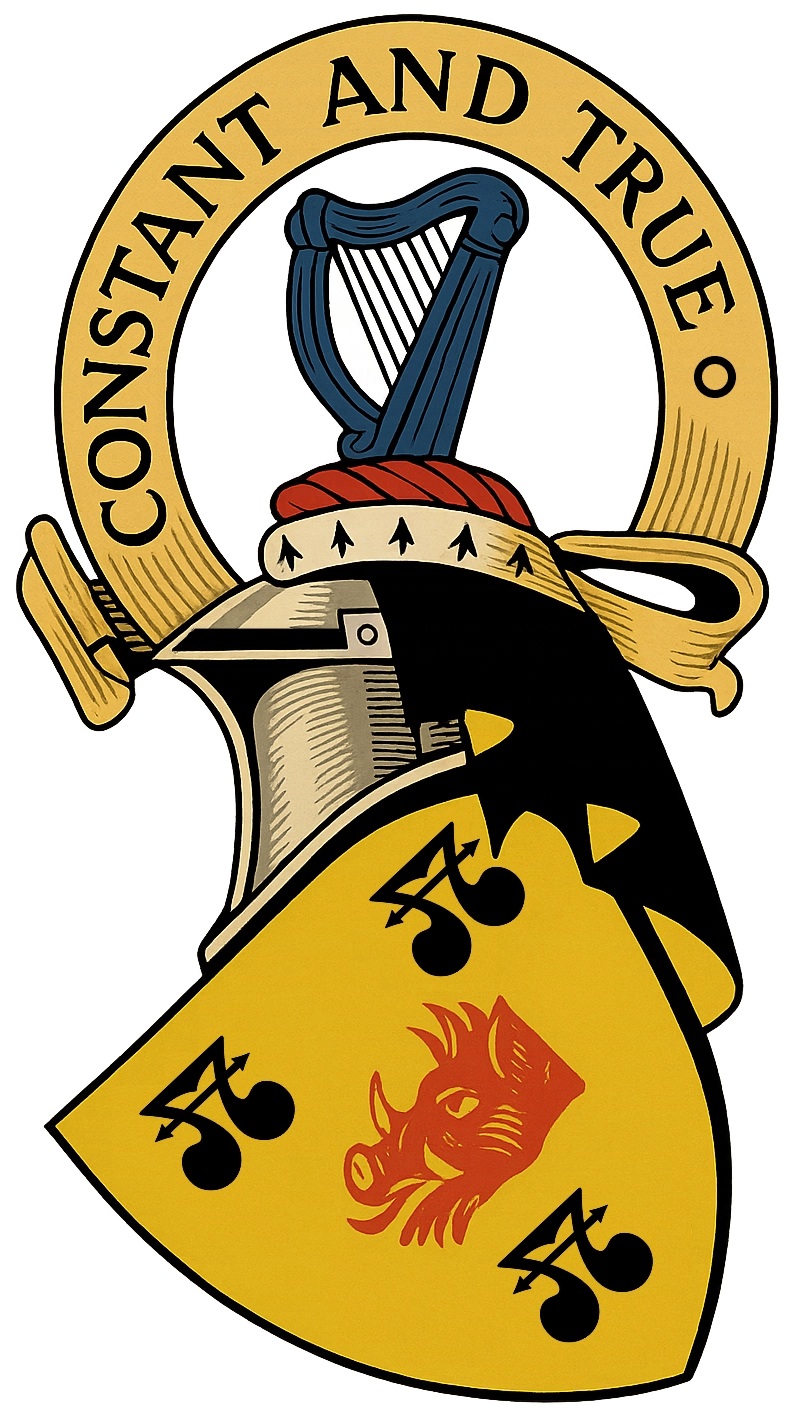
Set beside Scotland, the kin-name "de Ros/Roos/Rose" signals a shared Anglo-Norman horizon rather than a single, unbroken documentary chain. The Roses of Kilravock—earlier styled "of Geddes" and established by the later medieval period on the Nairn—belong to that horizon: an archipelago of baronial strongholds, co-heiresses and wardships linking Yorkshire's red stone to the Moray Firth. Read in this key, the Vachell connections do not claim a straight line to the chiefs of Clan Rose; instead they sketch a c. 1200–1700 arc of names, marriages and places that place Coley within the same cultural weather system as Helmsley, Holderness and Kilravock. As a contemporary note, the curators of this site are members of Clan Rose.
The Swedish chapter follows naturally. After 1703–1710, when Christoffer Leijoncrona served as Sweden's envoy in London, the Vachell link enters Swedish noble registers through his marriage to Françoise Vachell and, a generation later, through Hedvig Leijoncrona (1698–1770) into the house of Rappe. In that sense, the "Clan Rose connection" is as much about the movement of families and ideas around the North Sea rim as it is about descent: Helmsley and Holderness → Yorkshire gentry → Coley Park → London salons → Mönsterås and Stockholm.
Further Reading:
- Rappe Petersson, Tommie (2025). The Early Anglo-Norman History of Clan Rose of Kilravock. Uppsala: Clan Rose International.
- Cokayne, G. E., Gibbs, V., Doubleday, H. A., et al. (eds.) (1949–). The Complete Peerage, vol. XI: Ros (of Helmsley). London: St Catherine Press.
- Rose of Kilravock, Hugh (1848). A Genealogical Deduction of the Family of Rose of Kilravock. Aberdeen: The Spalding Club.